SME Lending Toolkit Helps Credit Unions Disburse $41 Million in Loans
WOCCU TIFI Project releases learning brief on successful pilot program
23 April 2024
MADISON, Wis.—A toolkit developed by World Council of Credit Unions’ (WOCCU) Technology and Innovation for Financial Inclusion (TIFI) Project in collaboration with partner credit unions led to the distribution of 1,767 loans worth $41 million to small and medium enterprises (SMEs) in four countries.
Those are some of the results from the SME Lending Toolkit pilot program conducted in partnership with five credit union associations, 23 individual credit unions and one credit union service organization in Kenya, Burkina Faso, Senegal and Guatemala.
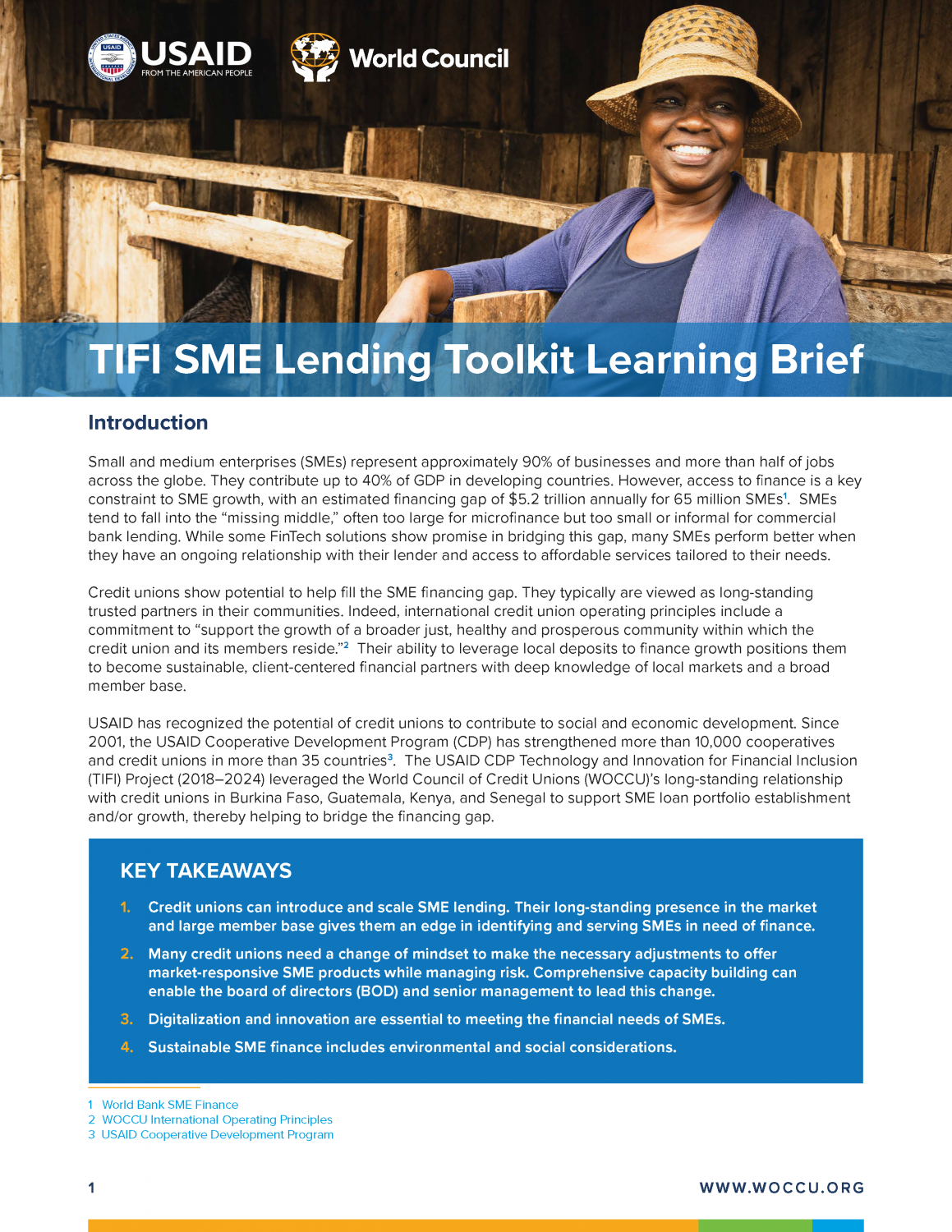
That data and the lessons learned from the pilot are featured in the new TIFI SME Lending Toolkit Learning Brief, which also shows the average loan ranged from roughly $11,000 in Kenya to more than $102,000 in Guatemala, with just a 1.53% portfolio at risk.
“Many of these credit unions had experimented with SME finance in the past, but the high portfolio risk drove them to reduce or stop that lending altogether. The SME Lending Toolkit took a holistic approach by supporting credit unions to leverage the strengths of the cooperative model, while adjusting their strategies, staff capacity and operations to the needs of SMEs. It has allowed them to increase their SME portfolios and better manage their risk,” said Eileen Miamidian, WOCCU Technical Director of Inclusive Financial Services.
The implementation of the toolkit also generated a series of important lessons for credit unions seeking to increase outreach to SMEs in their markets, including that:
- Credit unions can play an important role in financing SMEs. Their presence in the market and large member base gives them an edge in identifying and serving SMEs in need of finance.
- Many credit unions require a change of mindset to make the adjustments needed to offer market-responsive SME products while managing risk. Comprehensive capacity building can enable the board of directors (BOD) and senior management to lead this change.
- Digitalization and innovation are essential to meeting the financial needs of SMEs.
- Sustainable SME finance includes environmental and social considerations.
The TIFI Project is a six-year activity funded by the USAID Cooperative Development Program (CDP) that will conclude in August 2024. WOCCU is continuing the work of the TIFI Project and expanding on it in those same four countries through USAID-CDP Accelerating Growth and Inclusion in Lending for Credit Unions (AGIL4CU) Project (2023-28).
The AGIL4CU Project is further advancing the ability of credit unions to provide value to their members and contribute to the economic development of their communities, while extending business and climate financing to underserved market segments, including women and youth.
Click here to read the TIFI SME Lending Toolkit Learning Brief in its entirety.
World Council of Credit Unions (WOCCU) is the global trade association for the credit union movement, advancing cooperative finance worldwide. Through advocacy, education and more than 300 technical assistance programs in 90 countries, WOCCU advances financial inclusion and strengthens cooperative finance across diverse markets. Globally, more than 67,000 credit unions across over 100 countries serve more than 412 million people and hold over $3.8 Trillion (USD) in assets. Learn more at www.woccu.org.

Organization: World Council of Credit Unions
E-mail: lstanislawski@woccu.org

NOTE: Click on photos to view/download in high resolution.